The Stories of Immigration to Chicago

Immigrants learned that to survive and prosper in a hostile urban environment of unleashed capital, they needed to stick together. Mutual aid societies and houses of worship provided support and kept their histories and languages alive. The strong communal bonds that could in effect relocate a European village to a single tenement are evident today in many of Chicago’s neighborhoods. While the points of origin may have changed over the years, Chicago continues to welcome a significant immigrant population.


Decades of Immigrants
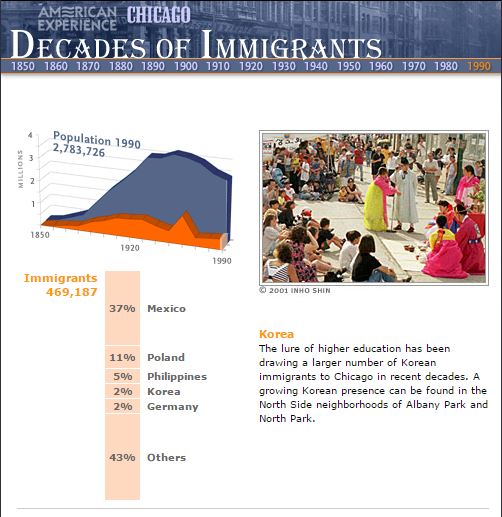
Examine Chicago’s top immigrant groups decade by decade, in U.S. Census data from 1850 until 1990. Each year highlights a different country of origin from the top five immigrant groups of that year.

1850 (France)
1860 (Scotland)
1870 (Norway)
1880 (Ireland)
1890 (England)
1900 (Bohemia)
1910 (Austria)
1920 (Russia)
1930 (Germany)
1940 (Sweden)
1950 (Poland)
1960 (Italy)
1970 (Mexico)
1980 (Philippines)
1990 (Korea)


Source: www.pbs.org

The use of the word ‘lure‘ in the image above without mentioning that (im)migration is a such a big decision that to imply that a whole group (im)migrates because of only one reason seems troublesome. 

(im)migration involves both push and pull factors. People will often be prompted to leave their country because of a push factor (war, economy, environment), then they choose which country to go to for it’s pull factor (liberal immigration policy, availability of jobs and availability of freedoms). 

Although interesting, many of these synopses are so oversimplified as to be misleading. 
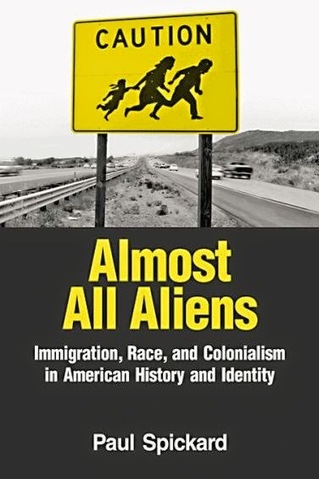
Almost All Aliens: Immigration, Race and Colonialism in American History and Identity

Book Description from Amazon:

“Almost All Aliens offers a unique reinterpretation of immigration in the history of the United States. Leaving behind the traditional melting-pot model of immigrant assimilation, Paul Spickard puts forward a fresh and provocative reconceptualization that embraces the multicultural reality of immigration that has always existed in the United States. His astute study illustrates the complex relationship between ethnic identity and race, slavery, and colonial expansion. Examining not only the lives of those who crossed the Atlantic, but also those who crossed the Pacific, the Caribbean, and the North American Borderlands, Almost All Aliens provides a distinct, inclusive analysis of immigration and identity in the United States from 1600 until the present.”


– Click through for more –


Source: communityvillageus.blogspot.com

HT Sharon H Chang @multiasianfams 

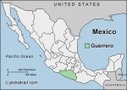
Massacres in Mexico underscore government collusion with cartels


Two recent massacres tell the story of human rights failures in Mexico. One massacre was committed by municipal police in Iguala, the second one by Mexican soldiers in Tlatlaya. Both occurred in areas teeming with crime, and activists have linked each one to a government increasingly powerless against drug cartels and violence.


– Click through to read more –


Source: mexicoinstitute.wordpress.com

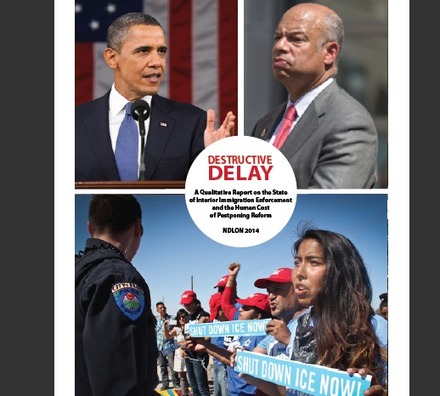
REPORT: DESTRUCTIVE DELAY: THE STATE OF IMMIGRATION ENFORCEMENT AND THE HUMAN COST OF POSTPONING REFORMS


Destructive Delay, written by Tania Unzueta and co-authored by B. Loewe, illuminates the inhumane interior Immigration and Customs Enforcement practices that continue unabated while the President postpones action and it highlights the human cost of the delay. The key findings shed light on an agency driven by one calculated mission, to meet a draconian deportation quota, regardless of the costs to public safety, institutional integrity, moral or constitutional considerations.

Through almost three dozen interviews with front-line organizers, legal experts, and people in deportation proceedings, Destructive Delay collects previously disparate and disconnected stories of the lived experience of ICE enforcement activity into a single document. The report provides real-life context for the rhetoric of the debate and gives an inside look into how immigration policy is actually working on the ground.


Source: www.notonemoredeportation.com

Migrant Child Labor in the United States [VIDEO]


Posted on July 21, 2010 by WITNESS


This post was written by Chanchala Gunewardena
, (Clark University 2011), Summer 2010 intern in WITNESS’ Communications department.

Last Thursday, WITNESS was invited to The Paley Center for Media for a screening of a special segment of NBC’s Dateline, titled America Now: Children of the Harvest. This piece, a follow up to a 1998 Emmy Award winning report on migrant farm workers and their families, attempts to see, what has developed and changed in the lives of a particular group of people twelve years on. More specifically however, it is focused on the issue of child labor, as migrant families who work in the agricultural sector tend to be assisted in their work by their whole family, including children under the legal working age (for this specific sector) of twelve.


– Click through for more –


Source: blog.witness.org

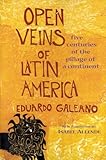
Open Veins of Latin America: Five Centuries of the Pillage of a Continent: Eduardo Galeano


Book Description


Since its U.S. debut a quarter-century ago, this brilliant text has set a new standard for historical scholarship of Latin America. It is also an outstanding political economy, a social and cultural narrative of the highest quality, and perhaps the finest description of primitive capital accumulation since Marx.

Rather than chronology, geography, or political successions, Eduardo Galeano has organized the various facets of Latin American history according to the patterns of five centuries of exploitation. Thus he is concerned with gold and silver, cacao and cotton, rubber and coffee, fruit, hides and wool, petroleum, iron, nickel, manganese, copper, aluminum ore, nitrates, and tin. These are the veins which he traces through the body of the entire continent, up to the Rio Grande and throughout the Caribbean, and all the way to their open ends where they empty into the coffers of wealth in the United States and Europe.


– Click through for more –

Source: www.amazon.com


Money can move across borders.


Raw materials can move across borders.
Manufactured goods can move across borders.


People (especially the poor) are highly restricted from moving across borders.


People should have the freedom and liberty to move where the resources and jobs are located.

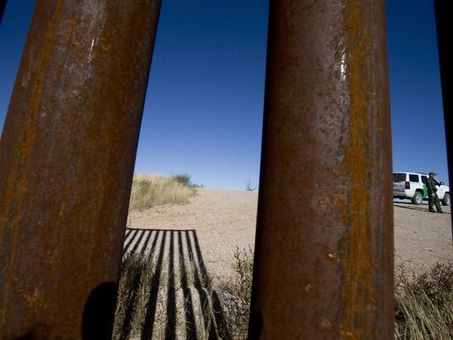
CBP: No agents disciplined for deadly force since 2004

Customs and Border Protection’s acting Internal Affairs chief said Friday that he is unaware of any Border Patrol agent or CBP officer being formally disciplined for killing someone through the use of force since at least 2004.

Source: www.azcentral.com

Obama draws flak over immigration reform delay

Insisting that factors beyond his control had created an untenable political situation, President Obama said Saturday that he would postpone his promised executive action to make drastic changes to the immigration system — a delay that leaves tens of thousands of immigrants open to deportation and millions more in limbo.

Source: www.latimes.com

U.S. Immigration Before 1965


January 1, 1892
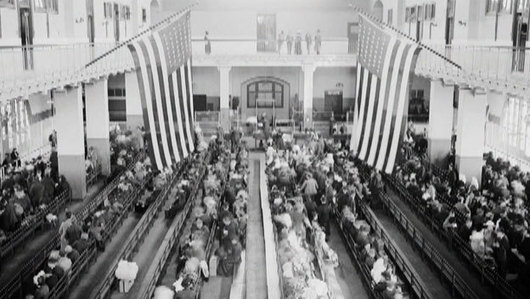
, Annie Moore, a teenager from County Cork, Ireland, was the first immigrant processed at Ellis Island. She had made the nearly two-week journey across the Atlantic Ocean in steerage with her two younger brothers. Annie later raised a family on New York City’s Lower East Side.


Some of America’s first settlers came in search of freedom to practice their faith. In 1620, a group of roughly 100 people later known as the Pilgrims fled religious persecution in Europe and arrived at present-day Plymouth, Massachusetts, where they established a colony. They were soon followed by a larger group seeking religious freedom, the Puritans, who established the Massachusetts Bay Colony. By some estimates, 20,000 Puritans migrated to the region between 1630 and 1640.

A larger share of immigrants came to America seeking economic opportunities. However, because the price of passage was steep, an estimated one-half or more of the white Europeans who made the voyage did so by becoming indentured servants. Although some people voluntarily indentured themselves, others were kidnapped in European cities and forced into servitude in America. Additionally, thousands of English convicts were shipped across the Atlantic as indentured servants.


– Click through for more –


Source: www.history.com


This article mentions the Chinese Exclusion Act of 1882 but fails to mention the Asian Exclusion act of 1924.


It also fails to mention that non-Europeans were not allowed to become citizens at many points in U.S. history.


People born in India were not allowed to become US citizens till 1946.


All Asians were allowed to become citizens in 1952 with the Walter–McCarran Act.


If we do not talk about citizenship rights when we talk about immigration, we are missing half of the discussion about dignity, respect and humanity.


Today’s social injustice issue is still about who is allowed to immigrate and become a citizen.


History shows that humans were allowed to (im)migrate to the U.S. for both religious and economic reasons.


Today’s (im)migrants move for reasons of survival (like the Irish did).

And they also move as war refugees, climate refugees, economic refugees and political refugees.


Drop the i-Word.


No human is illegal.