Subject of iconic photo speaks of anger, excitement


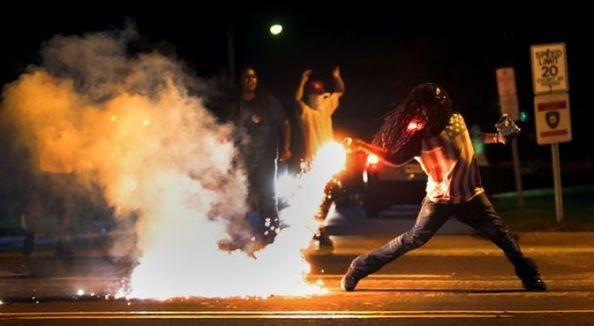
This is Edward Crawford.

He’s 25, went to University City High School and works at a bistro on the Delmar Loop. He’s a waiter, a roller skater and a father of three.

And, just after midnight on Aug. 13, he grabbed a sparking, smoking tear gas cylinder, fired by police at Ferguson protesters, and threw it back.

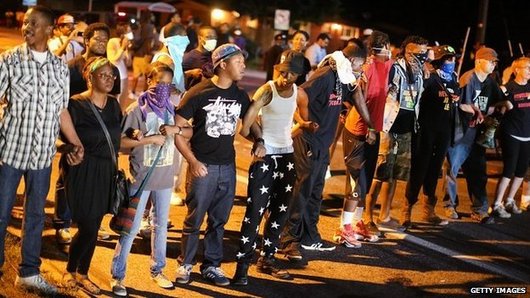
The photo, taken by Post-Dispatch photographer Robert Cohen, has become an iconic image of the now two-week protest along West Florissant Avenue.

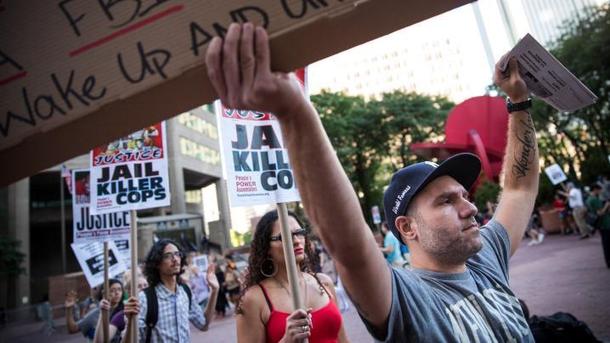
For many, the act bottles up all the anger directed at police after the shooting of unarmed black teen Michael Brown. It represents defiance against police aggression. And the shirt Crawford is wearing, with the American flag down the middle, identifies the irony of the moment.

But Crawford says he wasn’t angry when he threw it. He was angry beforehand. Afterward — as he was being dragged out of a car, cuffed and jailed — he was mostly just scared.

And throwing it wasn’t an act of rebellion, he said. It was instinct.


– Click through to read more –


Source: www.stltoday.com


One of my all time favorite photos.

#AntiOppression


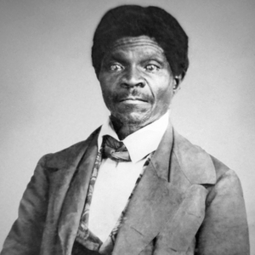
Ferguson Protests Erupt Near Grave of Ex-Slave Dred Scott, Whose Case Helped Fuel U.S. Civil War


AMY GOODMAN: Just miles down the road from the scene of protests in Ferguson, we’re hearing a lot about Florissant. Just down Florissant is the grave of Dred Scott, who’s buried in the Calvary Cemetery on West Florissant Avenue. Born a slave in Virginia, Dred Scott sued in a St. Louis court for his freedom. The case went to the Supreme Court, resulting in a landmark Supreme Court decision that’s called the worst ever. In 1857, the court ruled African Americans were not citizens of the United States, and therefore had no rights to sue in federal courts. The court described blacks as, quote, “beings of an inferior order, and altogether unfit to associate with the white race, either in social or political relations, and so far inferior that they had no rights which the white man was bound to respect,” unquote. Again, the Dred Scott decision, considered the worst decision in the history of the Supreme Court, in the slave state of Missouri, the seven-to-two decision. The chief justice was a slave owner himself. In fact, a number of the Supreme Court justices were slave owners themselves.

To talk more about the significance of this case today, we’re joined by Kimberlé Crenshaw, professor of law at UCLA and Columbia University, founder of the African American Policy Forum.

Kimberlé, thank you for joining us. Professor Crenshaw, talk about the significance of Dred Scott’s body just lying down the road on Florissant, the road we’ve heard so much about, as these protests continue and escalate.


KIMBERLÉ CRENSHAW:
 Well, really couldn’t be more symbolic. As you point out, Dred Scott is widely regarded as being one of the worst cases ever. And there are two ways in which we might see its relevance in this particular moment. One, when the Supreme Court was trying to decide whether African Americans could be citizens, what they considered was the way African Americans were treated. They weren’t necessarily looking at formal law. In a lot of ways, free blacks had more rights than white women did. But the overall idea was that they could be enslavable. The overall idea is that they weren’t seen as having the same social worth as white Americans and could be enslaved for their own good. So the very possibility of their enslavability meant that, at least as far as the founders were concerned, they were going to be forever and permanently a stateless people. And that would have likely been the case had the case not led to a civil war.


Source: www.democracynow.org

“A Human Rights Crisis”: In Unprecedented Move, Amnesty International Sends Monitors to Ferguson


AMY GOODMAN: This is Democracy Now!, democracynow.org,The War and Peace Report. I’m Amy Goodman. As we continue to look at the situation in Ferguson, Missouri, we’re joined by the executive director of Amnesty International USA, which has taken an unprecedented step in sending a 13-person delegation to monitor the developments in Ferguson. Amnesty has never before deployed observers inside the United States.

We’re joined here in our New York studio by Steven Hawkins, who has also worked as an attorney with the NAACP Legal Defense Fund, where he represented African-American men facing the death penalty throughout the Deep South in the United States.

Welcome to Democracy Now!, Steven.


STEVEN HAWKINS:
 Pleasure to be here.


AMY GOODMAN:
 Talk about this decision.


STEVEN HAWKINS:
 Well, Amnesty saw a human rights crisis in Ferguson, and it’s a human rights crisis that is escalating. We sent observers down because there was a need for human rights observers. Clearly there are violations of international human rights law and standards, in terms of how the policing is being done on protests. So, for example, we’ve issued reports on, for example, Israel and the Occupied Territories, how tear gas is supposed to be administered—never in an indiscriminate way where children and the elderly could be subject to very harmful effects, even death, from tear gas. So, we sent down observers to be on the ground. We have been thwarted in our efforts to be able to go out on curfew with the police, which would be a clear standard in these circumstances, as well as the opportunity for the press to be able to be in the space. So, we also went down to make sure that the citizens in Ferguson understood that the eyes of the world were watching, that Amnesty is deeply supportive, and we will be continuing to monitor the situation.


Source: www.democracynow.org

Lessons From Ferguson, Missouri: The People Deserve an Army


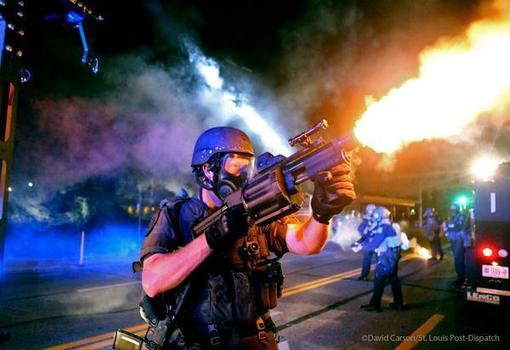
The little town just 20 miles north of St. Louis made national headlines a few days ago when protests turned to riots over the death of unarmed 18 year-old Black resident Michael Brown. Riots since then have only intensified and clashes with the police becoming more common. A no-fly zone has been established and something of a ‘media blackout’ has occurred as two reporters have been arrested and pictures show police firing tear gas at what seems to be other journalists trying to report on the situation.

Ferguson, Missouri is effectively under Martial Law. Images of heavily armed men aiming upon angry crowds light up social media as politicians (now including President Obama) craft their state-sponsored “opinions”.


– Click through for more –


Source: anti-imperialism.com

Who’s Illegal? – Jasiri X Ft Rhymefest


In response to repressive anti-Immigration legislation SB1070 and HB56, Jasiri X, Rhymefest, and Paradise Gray traveled to Arizona and Alabama courtesy of the Sound Strike to see first hand how these unjust laws break up families, fracture communities and destroy lives.

“Who’s Illegal?” asks the question, can a nation on stolen land, built by stolen people define another group of human beings as illegal? “Who’s Illegal?” was produced by GM3 and directed by Paradise Gray.


Source: www.youtube.com